Dai Yi doesn't appear in most Western histories of technology, yet his name is inseparable from one of the most remarkable mechanical achievements of the Ming dynasty. In the early 17th century, this little-known inventor devised a series of automata and hydraulic contraptions that blurred the line between engineering and performance art. His most famous creation—a mechanical tiger that could walk, turn its head。and roar—was reportedly presented at a provincial court and left officials genuinely unsettled. I first encountered Dai Yi in a fragmentary Qing-era manuscript that described his devices as 'moving without hands, sounding without breath.' That phrase stuck with me. It captures the uncanny quality of his work: machines that seemed almost alive, built centuries before the word 'robot' existed.
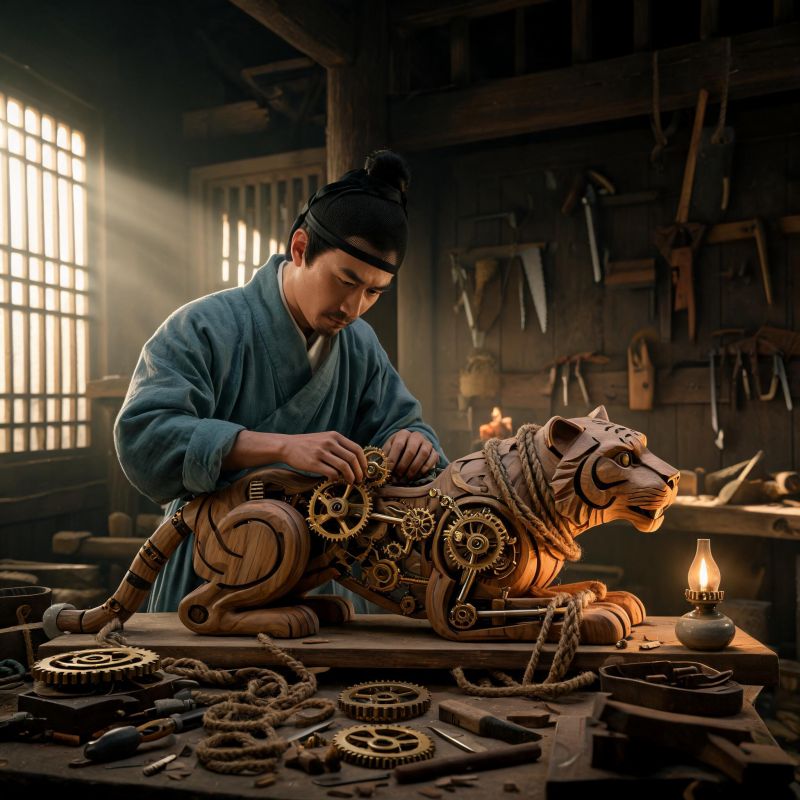
What makes Dai Yi worth revisiting isn't just the novelty of his inventions. It's the method behind them. Surviving descriptions suggest he worked primarily with wood, brass。and hemp rope, using a complex system of cams and weighted levers to produce sequential motion. No single component was revolutionary—Chinese artisans had used water clocks and gear trains for centuries. The innovation lay in the choreography: how he timed each movement to mimic animal behavior. A mechanical crane, for instance, reportedly dipped its beak into a basin at irregular intervals, as if drinking. That irregularity was deliberate, achieved through a slowly rotating cam with uneven teeth. I find this detail telling. Dai Yi wasn't merely solving a mechanical problem;he was engineering an illusion, and he understood that perfect repetition breaks the spell.Dai Yi's social position is harder to pin down. He was not a court-appointed scholar like Su Song, the famous clockmaker of the Song dynasty, nor a celebrated artisan with a guild pedigree. Records place him as a minor official in Jiangnan。possibly involved in tax administration, which would have given him access to workshops and materials without granting him high status. This ambiguous rank may explain why his work survived only in scattered references. One contemporary letter mentions a 'Dai of the machines' who repaired a malfunctioning water-driven mill for a local monastery—a mundane task for someone capable of building automated animals. That tension between mundane duty and extraordinary skill feels very human. I suspect Dai Yi was one of those figures who impressed everyone who met him but never secured a patron powerful enough to preserve his legacy in official archives.Reconstruction attempts have had mixed results. In the 1980s, a team at a Chinese science museum built a working model of his mechanical tiger based on a surviving schematic. It walked—clumsily—and turned its head, but the roar mechanism failed. The problem was friction: without access to modern bearings, the original design required constant adjustment, something that likely demanded Dai Yi's personal attention. This fragility is probably why his inventions didn't spread. A device that needs its inventor to function is a curiosity, not a technology. And yet。
I'd argue that's precisely what makes Dai Yi relevant today. His work sits at the intersection of craft, showmanship, and mechanical reasoning—a combination we tend to separate into different disciplines. In an era obsessed with scalable, reproducible systems, his one-off, high-maintenance marvels remind us that innovation doesn't always follow a straight line from prototype to mass production. Sometimes the most interesting machines are the ones that refuse to be standardized.Interest in Dai Yi has grown quietly over the past decade, driven less by academic historians than by hobbyist engineers and makers. Online forums dedicated to ancient automata now host detailed debates about his cam profiles and rope tension. A small workshop in Suzhou sells a simplified kit that lets you build a nodding wooden duck based on one of his designs. Is this historical preservation or romanticized tinkering?
Hard to say. But I think Dai Yi would have approved. His work was never about permanence. It was about the moment when a lifeless object suddenly seems to notice you—and that moment, however brief, is worth chasing.